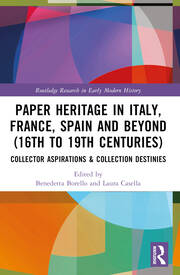
Paper Heritage in Italy, France, Spain and Beyond (16th to 19th Centuries). Collector Aspirations & Collection Destinies
Benedetta Borello, Laura Casella, eds. Abingdon, Oxon: Routledge, 2025, 340 pp., 1 B/W illustration.
Paperback €55.99, eBook €44.79. ISBN 978-1-032-44800-8 (paperback), ISBN 978-1-003-37397-1(eBook).
by Bénédicte Miyamoto
This volume of essays, resulting from a 2021 seminar, recentres the collector by adopting a micro-history perspective on cultural consumption. The book historians, cultural studies and material culture researchers who collaborated on the 12 essays in this volume examine the accumulation, valorisation, and transmission of paper in all its forms – from books to catalogues, from letters to inventories – assembled through collecting practices. The title contextualizes the study in 16th to 19th century Italy, France Spain and beyond. While the case-studies remain overwhelmingly Italian and 17th century in focus, the methodology draws upon a rich material culture historiography, especially from scholars of 16th- to 19th-century Spain and France. The volume stands out for its meticulous presentation —including references, an index, and footnotes—and is introduced by a thoughtfully crafted opening essay.
The stated originality of these studies suggests that while recent, synthetic studies of libraries have examined collectors within their cultural backgrounds, such identities often end up being “absorbed by a socio-political context that has already been established, and they are considered mere representatives of it” (p. 5). While the focus on collectors is not new to the field of collecting and display studies, this book’s sustained attention to the archival aspirations of collectors offers a fresh perspective. The notion of “paper heritage” developed across these 12 essays focuses on the collectors’ often obsessive relationship with their papers, their strategies for ordering and valuation, and their compulsive care for transmission.
Members of the Society for the History of Collecting recognize Susan Pearce’s foundational research on the collector’s meticulous obsession for identifying, finding, acquiring and accumulating objects. Following Renata Ago’s identification of the collector’s desire for longevity – or the “right to durability” – this volume highlights how the collecting impulse is also characterized by an obsessive ordering that translates into extreme care for transmission. This is visible for example when the “miniaturisation of knowledge on paper and valorisation of the entire collection, as well as implicitly of the person who had created it, was realized in the drawing up of the inventory” (73). Recent research has uncovered the mobility, and indeed the volatility, of collections – whether exhibited in galleries or held in museums and libraries. It is consequently timely to investigate the roots of the collectors’ deep-seated desire for the immobility and preservation of their collections – not only as artifacts assembled in one space, but as artifacts kept together by an array of descriptions, lists and indexes committed to paper. This creates a bureaucracy of records – or “paper heritage” – intended to function as a mirror for the collection. Indeed, if collecting studies have long been interested in the “mise en scène” (display) of a collection, there is now a sustained interest in the “mise en place” – how objects are organized, staged, and related to one another to produce meaning.
The volume of essays focuses on the intentional arrangement that arise from the process of documentation, a form of collection validation that is emphasized here over possession.
The volume is arranged in 4 parts, organized by actor: (1) Physicians and nuns; (2) Men of Letters; (3) Mathematicians and Jurists; (4) Patrons. Each part in fact delves into separate systems powered by paper: (1) record-keeping; (2) sociability (3) bureaucracy, and (4) legacy – a pertinent epistemological organisation that would have gained from being made apparent in the titles. The focus on processes in paper heritage would have better defined collecting practices than the stated focus on different professions and actors.
Part I examines how record-keeping confers value through accumulation. MORALEJO ORTEGA investigates the fate of Catalina de Mendoza’s library collection, identifying a “bibliophile attitude” (p. 30) earlier than traditionally recognized, building on Surekha Davies research on “catalogical encounters”. This erudite chapter demonstrates that a micro-historical methodology is better suited to recovering female collectors than more synthetic studies. BORELLO investigates Paolo Beni’s controlled inventories – a type of obsessive record-making that creates a “swirling circuit of information, advice and recommendations” (p. 44). By engaging with provenance studies, she recognizes that collectors’ “disorganized organisations known only to them” (p. 10) provide significant evidence of the extreme care certain collectors took regarding paper heritage – an issue central to the book’s primary theory. Finally, CASELLA and ADANK study Pompeo Caimo’s library as a professional inheritance, “constituting bargaining chips to mark the prestige of the house” (p. 93), and making a well-supported case for paper heritage as a form of economic patrimony.
Part II focuses on paper heritage as a form of sociability, constantly reconfigured by transmission. VOLPINI studies the library of Girolamo da Sommaia as both an intimate archive and a shared cultural project by examining inventories inventory and diary, and emphasizes that books and manuscripts, circulating as copies or loans, made paper heritage eminently mobile. VALERI similarly investigates the dal Pozzo library as “the fruit of donations, purchases, exchanges, individual gifts, a continuous and dynamic flow of data to reconstruct,” (p. 132), but also emphasizes the continuous cross-referencing between book and art collections and recovers the owner’s anxiety regarding transmission without dispersion. CHAPRON investigates the precariousness of paper heritage, noting its liability to appropriation by disciples or destruction by heirs who found papers burdensome. This chapter warns against taking at face value collectors’ “systematically depreciatory way of referring to one’s working instruments” (p. 139) a rhetoric that may have led researchers to undervalue the serendipitous pleasure collectors found in constantly arranging their papers, in an effort to ward off the evils of transfer.
Part III investigates the professional communities bound by the bureaucracy of knowledge. Two book history case studies, by FAVINO on collecting mathematics in Rome, and by FECI on professional law libraries, are brilliant reconstructions of books as multifunctional tools of knowledge, reputation, and professional exchange, even if they may be of less immediate interest to some members of the Society for the History of Collecting (SHC).
Part IV documents the legacy of paper heritage, especially through the use of space. MAZZETTI DI PETRALATA’s chapter on the Galleria Giustiniana delves into the intricate motivations for record-keeping that extend beyond simple inventory operations, hinting at a fundamental need for reputational control. FIORELLI shows how the “sedimentation of [the Capece Minutolo family’s] precious collection of papers intersects with the family events” (p. 239), as the collectors shifted from projecting an aristocratic identity through their collection to using it for philanthropic militancy. Similarly, both JORNET-BENITO and BOREAN investigate collectors’ preoccupations for the “afterlives” of their paper collections – demonstrating how these paper trail often functioned as paper museums and bequeathed personal archives, that served as supplements and complements to the owners’ physical galleries.
The primary value of these micro-histories for SHC members lies in the link forged between valorising and transmitting. Rather than treating these as two distinct chronological steps (occurring before and after the decease), the authors demonstrate that they are united by the collectors’ control strategies. Transmission is re-infused with the profound affective relationship between a collector and their papers. It is shown to be significantly more than a bureaucratic notarial act, which gives all its meaning to the term paper heritage. These case studies, drawing on an impressive and rich array of unpublished letters, catalogues, inventories and diaries, are also a timely reassertion of the cohabitation in the early modern and modern period of print and manuscript within paper heritage.