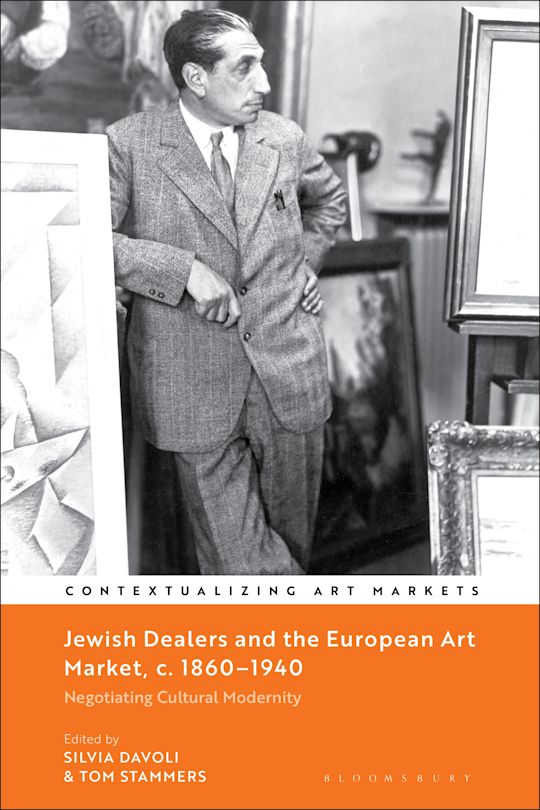
Jewish Dealers and the European Art Market, c. 1860-1940. Negotiating Cultural Modernity
Silvia Davoli, Tom Stammers, eds. London: Bloomsbury, 2025, 336 pp., 12 colour and 80 B/W illustrations.
Hardback £85.50, eBook £68.40. ISBN 978-1-350-47368-3 (hardback), ISBN 978-1-350-47370-6 (eBook).
by Elizabeth Pergam
In the literature on collecting and the art market, it hardly needs to be stated that the art dealer plays a pivotal role. Most frequently the modifier attached to the trader of art is “French,” reflecting the overwhelming emphasis on France in histories of art and the art market. Recent exhibitions on Paul Durand-Ruel and Ambroise Vollard, for example, recognize public interest in the dealers who placed paintings that are now icons of modernism into collections. Such exhibitions have consolidated the centrality of these two men in the ever-growing literature on the late nineteen and early twentieth century art market. Neither Durand-Ruel nor Vollard was Jewish. Why then has there long been a perception that Jewish dealers were over-represented in the art market between the Second Empire and the onset of WWII? The contributions to this volume edited by Tom Stammers and Silvia Davoli seek to highlight the positive impact of those who were born to Jewish parents while at the same time not to succumb to the negative tropes of the money-hungry, usurious Jewish dealer. In fact, the fourteen essays that compose this collection, nationality is even more significant than religious affiliation
Framed by the editors’ introduction and Charles Dellheim’s afterword, the core essays are primarily case studies of individual figures in the art trade. The first chapter, Kyrstyna Matyjaszkiewicz’s overview of Jewish dealers in Victorian London, is the sole contribution that lays out a broad overview of Jewish involvement in the art market in England from the 1840s through the 1870s. Not surprisingly France and Britain, specifically, Paris and London, are the geographic centers of gravity of the remaining chapters; however, a number of essays go beyond these borders to consider Venice (Nicholas Penny on Moisè Michelangelo Guggenheim), Germany (Malcolm Gee on Alfred Flechtheim), the United States (Julie Codell on Martin Birnbaum; Esmée Quodbach on Leo Nardus), and Russia (Shlomit Steinberg on the Birtchansky brothers).
Crucially, one of the recurring themes is the transnational nature of art dealing, where a notable strategy for success was to bring works of art from one country or region to buyers in another. As Elizabeth Emery, Gabriel Weisberg, and Fae Brauer explicate this business model was pursued by Florine Ebstein Langweil, Siegfried Bing, and Daniel-Henry Kahnweiler to name just three. Many of the subjects of these essays were themselves migrants and, therefore, subject to the prejudices not only of religious difference but also xenophobia. Although Germany was the origin of the assimilationist strand of Judaism (known as the Haskalah) developed by such intellectuals as Moses Mendelssohn, many of the Jewish dealers treated in this volume were emigrants from Hamburg, Frankfurt, and other German cities. They gravitated towards Paris or London, even as the Dreyfus Affair made overt at the end of the nineteenth century the virulent antisemitism present in France. Camille Mestdagh and Léa Saint-Raymond’s chapter on Sigismond and his son Charles Mannheim, charts the father’s move from Frankfurt to Paris in 1817 at the age of nineteen (p. 76). As Elizabeth Emery details, Florine Ebstein Langweil was one of many transplants from Alsace to Paris. So too was Nathan Wildenstein, the first of an art dealing dynasty that is not the subject of a dedicated essay, but referenced in Diana J. Kostyrko’s on Gimpel Fils, another family who moved to Paris after the Prussian annexation of Alsace in 1871.
Closely connected to this transnationalism are the familial connections that facilitated cross-border trading networks. With the subtitle “commercial cousinhood,” family ties are emphasized in Diana Davis’s chapter on Charles Davis, whose father Frederick married into the Falcke family, also dealers (p. 101). Another example of ways in which galleries were connected across national borders is Flechtheim’s expansion to a Frankfurt gallery in the early 1920s, which was enabled by Kahnweiler’s younger brother Gustav joining the firm (p. 205). Naming their gallery—Gimpel Fils—in London in 1946 announced both the emphasis Charles and Peter Gimpel placed on memorializing their father René, murdered in the Neuengamme Concentration Camp, as well as their French birth and the ties to the London art market that their grandfather Ernest Nathan Gimpel had forged when he began the family’s business (p. 218). René had married Florence Duveen, cementing the connection to Britain. These are just a few of the many examples, but, as Davis notes, marriage among art dealing families was common in non-Jewish firms, as well.
Another way to approach these essays in through the lens of specialization. Chapters on Jewish dealers of Asian art include Emery on Langweil, Weisberg on Sigfried Bing and Julius Meier-Graefe, and William G. Clarence-Smith on the Samuel family trade in East Asian curios. Not coincidentally, they were purveyors of the decorative arts rather than painting. Penny’s essay on Guggenheim’s trade in woodcarvings provides another example. Matyjaszkiewicz is not alone in making the connection between the tradition of Jewish trade in second-hand goods leading to the ‘step up’ to antiques.
The same lower financial barrier is one reason that Berthe Weill was a pioneer in the promotion of artists such a Picasso and Modigliani at the very beginning of their careers. Weill is not included in this volume, but was the subject of a talk by Julie Saul at the online conference organized in December 2021 by the editors that formed the source material for many of these essays and has been reclaimed for the historical record by a recent exhibition at the Grey Art Museum, NYU, and the Musée de l’Orangerie, as well as the translation of her memoir into English in 2022. The association of Jewish dealers—not always in a complimentary way—with the support of avant-garde art is addressed in Brauer’s essay on Daniel-Henry Kahnweiler, another German who moved to Paris and who was first targeted more for his national origin than for his religion with his stock confiscated during World War I. Giovanni Casini examines Léonce Rosenberg’s promotion of Cubism; Kahnweiler’s exile to Switzerland during the war, providing him with an opening (p. 186). None of the essays addresses dealers of Judaica.
Many of the essays emphasize the physical locations of the dealer; often the multiple moves track the increasing prosperity of the enterprise. Guggenheim first operated out of a showroom in the Palazzo Pisani Gritti (now the Gritti Palace Hotel), then taking over the entire Palazzo Balbi by 1877 (p. 58). Sigismond Mannheim’s successful growth from his jewellery shop at the Palais Royal was marked by his move to the rue de la Paix in 1841 where he was known for his stock of objects and curiosities (pp. 76-77). The mapping of these locations also indicates the interconnectedness of several of the subjects. For example, Langweil and Mannheim both had stores on the rue St. Georges in the 1880s (p. 131).
Most interesting to this reader were the many accounts of failed businesses in direct contradiction to the pervasive stereotype of the savvy Jewish businessman. As Matyjaszkiewicz notes Louis Victor Flatou and Lewis Durlacher both experienced bankruptcies as did Algernon Moses Marsden (p. 47). Gee details how Flechtheim’s first gallery, opened in Düsseldorf in 1913, was forced to close in 1917 due to the economic crisis precipitated by WWI. However, the subsequent economic depression and political collapse of the Weiner Republic led to Flechtheim’s exile in London (p. 209).
None of these themes is an exclusively Jewish domain. Very rarely does the subject’s religious observance enter the consideration of the author. Diana Davis notes that Charles Davis was a member of London’s Western Synagogue (p. 45). Martin Birnbaum was buried In a Jewish cemetery (p. 245). Where the distinction of religion occurs most forcefully is in the characterization of these figures in the press and in the antisemitic statements of their contemporaries. Weisberg’s essay on Siegfried Bing and Julius Meier-Graefe foregrounds the prejudices of the day. He concludes that Bing and other’s obscuring of their Jewish heritage was a strategy in the face of pervasive antisemitism (p. 124). Prefiguring German-Jewish strategies in response to Aryanization, Brauer details Kahnweiler’s post-WWI partnership with André Cahan in the Galerie Simon to avoid the French government’s confiscation of German property following the country’s default of war reparations (pp. 170-171). With the fall of France to the Germans, Kahnweiler protected the gallery by selling it to his stepdaughter, Louise Leiris, the daughter of Kahnweiler’s wife Léontine Alexandrine Godon, who was Roman Catholic. Given the chronological framework of the volume, the extent of Nazi persecution of Jews and its impact on the art market is only glancingly mentioned.
These essays grapple to a varying extent with the question of why art dealing was an occupation accessible to Jews. Davis addresses the fact that in Britain, many other professions were barred to Jews (p. 97). Several authors reference Charles Dellheim’s assessment from his Belonging and Betrayal: How Jews made the art world modern (Brandeis University Press, 2021) that in addition to the small amount of capital needed and their international networks, art dealing was a “good fit for Jews because they were…cultural interpreters and intermediaries.” Dellheim’s “Afterword: Why the Jew’s” restates “some of [his] conclusions…about the complex relationship between Jews, art and modernity” (p. 290). He criticizes the use of “assimilation” to describe the process by which Jews tried to find their place in post-emancipation Europe, preferring
“acculturation” to indicate the central role “cultural participation” played in their attempt to find acceptance (p. 292). Nevertheless, the difference between being a consumer of culture versus being a commercial agent has remained at the heart of the discomfort associated with art dealing. As Aviva Briefel argued convincingly in the chapter on Jewish dealers in her The Deceivers: Art Forgery and Identity in the Nineteenth Century (Cornell University Press, 2006) “Regardless of his relationship to art, the Jew is always a dealer” (p. 125) and by extension the dealer is always a Jew.