Collecting with a View:
A series introducing the research and collecting interests of our Steering Committee members
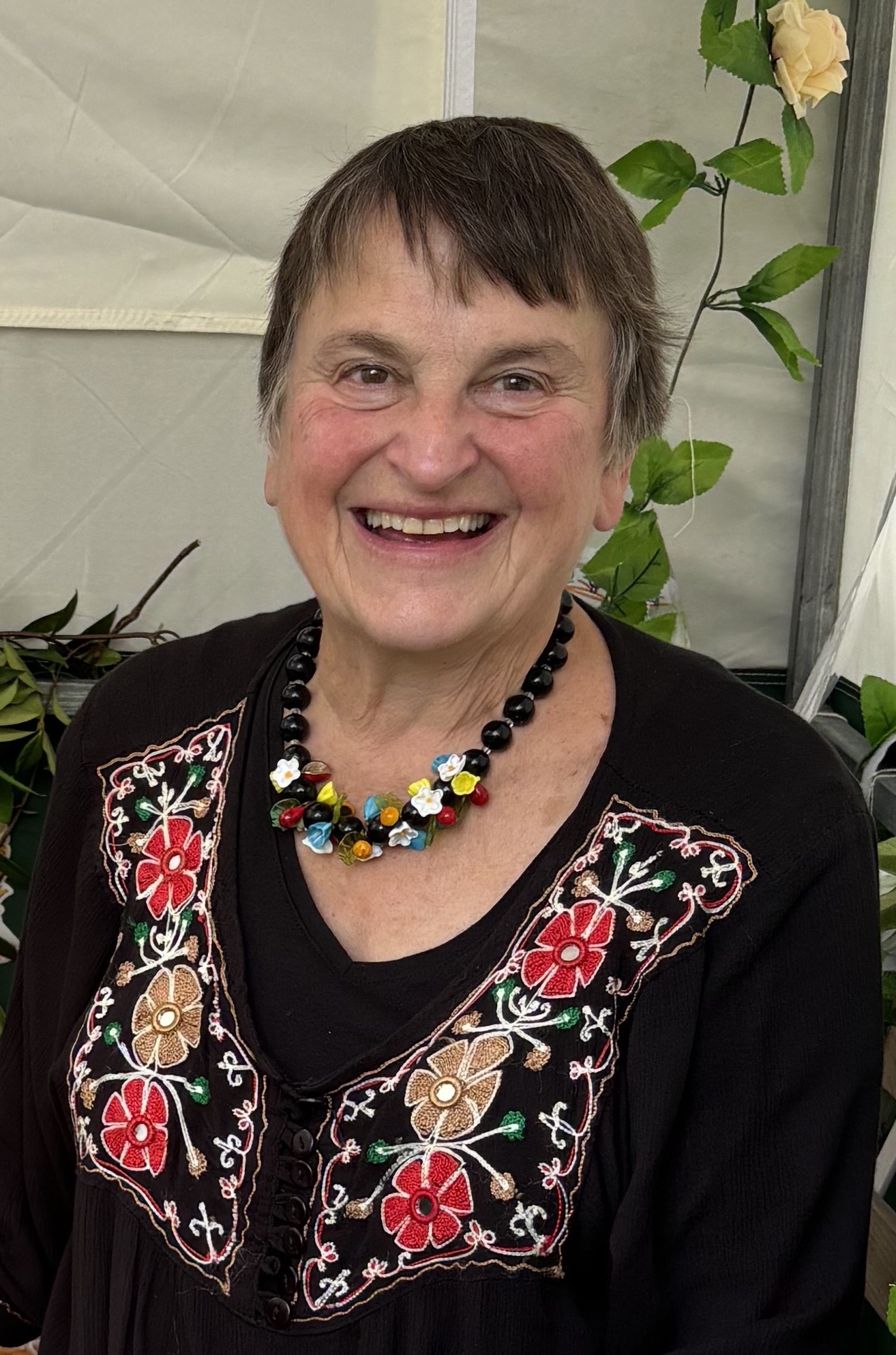
SUZANNE HIGGOTT
1-What are you reading at the moment?
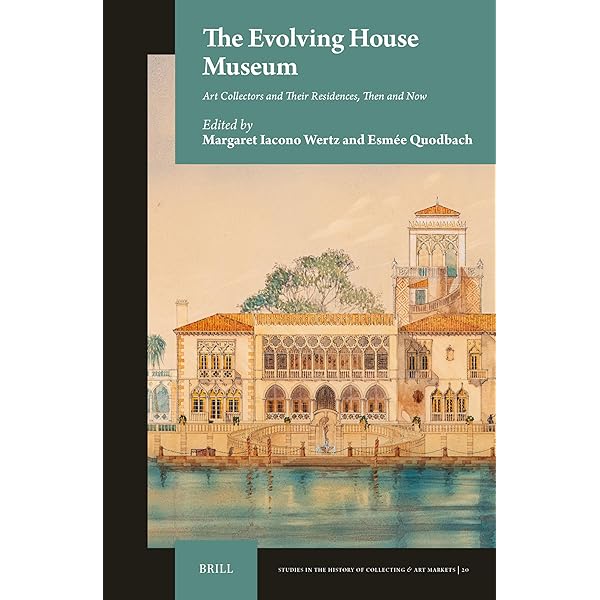
I am currently reading The Evolving House Museum which is a very recent publication from the end of last year (Margaret Iacono Wertz and Esmée Quodbach eds., The Evolving House Museum. Art Collectors and Their Residences, Then and Now, in ‘Studies in the History of Collecting & Art Markets’, Volume: 20, 2024). The book looks at how house museums have evolved from the early nineteenth century right through to the present day, through a series of essays. The house museums in this volume being specifically art collectors’ houses that have been opened to the public and/or become museums. It seems that the concept of the house museum, or the understanding of what it comprises, is very fluid and multifaceted. So, they’ve taken the subject of house museums founded or inspired by art collectors, and the collections that those collectors have brought together. There is a range of contributors, and the volume is divided into three parts. It’s very beautifully produced, and that is one of the reasons it’s very enjoyable to read: the format, the paper and the font are very nice and attractive. It is a real pleasure to study and to read it, so I’ve been enjoying that very much indeed. The idea for the volume came out of a Society for the History of Collecting online symposium held some years ago (The Evolving House Museum: Art Collectors and Their Residences, Then and Now, 18-19 June, 2021, organised and chaired by Margaret Iacono, Independent Scholar, Norwalk, Connecticut, and Esmée Quodbach, Independent Scholar, Princeton, New Jersey).
2-What are you working on at the moment?
I retired last year, so at the moment it’s a range of different projects. Firstly, the last project I was working on when I was still at the Wallace Collection was an essay about the provenance of the Asian and Ottoman arms and armour in the collection. That was an area that hadn’t been very much researched at all until recent years. The catalogue of the non-European arms and armour was first published in 1913, and then it was essentially a list with attributions written at a time when not all that much was known about the specific origins of arms and armour of that type. And that was basically reprinted several times until the 1970s. Hence, a thorough academic catalogue was needed and that has been worked on now for more than ten years and it has evolved. So now it should be published later this year or early next year. I did quite a lot of research in the Archives de Paris, a few years ago, and so discovered quite a lot about the provenances of the pieces in the Wallace Collection. I wrote an essay about that for the forthcoming catalogue and I’m currently reviewing the second round of proofs of that essay.
In addition, I am writing up a paper that I gave at an annual event that I went to last September, Study Days on Venetian Glass, which took place in Venice. Last year the subject was: Venetian glass in Spain, Portugal and Sicily and its influence on their glass production. I couldn’t talk about that theme specifically, but I’d seen a glass goblet of a type that I’d never seen before in a small museum in Lisbon, in Portugal. So I thought that was close enough. Hence, I am currently writing my paper up for publication. The goblet is enamelled, dated 1613 and it has on it the name of the Prince de Condé. I was really intrigued and none of the glass specialist colleagues I wrote to had seen anything like it. By a lot of detective work and some sheer luck, plus assistance from one or two colleagues, I discovered that there was a whole series of these goblets in a little private museum in Normandy, which I went to visit. It was a really fun project. In the end, I concluded that these glasses all had dates and names of seventeenth-century French aristocrats, but they were made in the late nineteenth century, probably by a firm called Heckert in Silesia. But why they were making in Silesia glasses enamelled with the names of French seventeenth-century aristocrats and seventeenth century dates, I have yet to find out. And the final episode, so far, with this project is that two Parisian curators who I know and a private collector from Paris, all independently sent me a photograph from a recent sale in Paris, showing more of these glasses with an estimate of about €70 each. So if I had been in Paris, I’d love to have bought them.
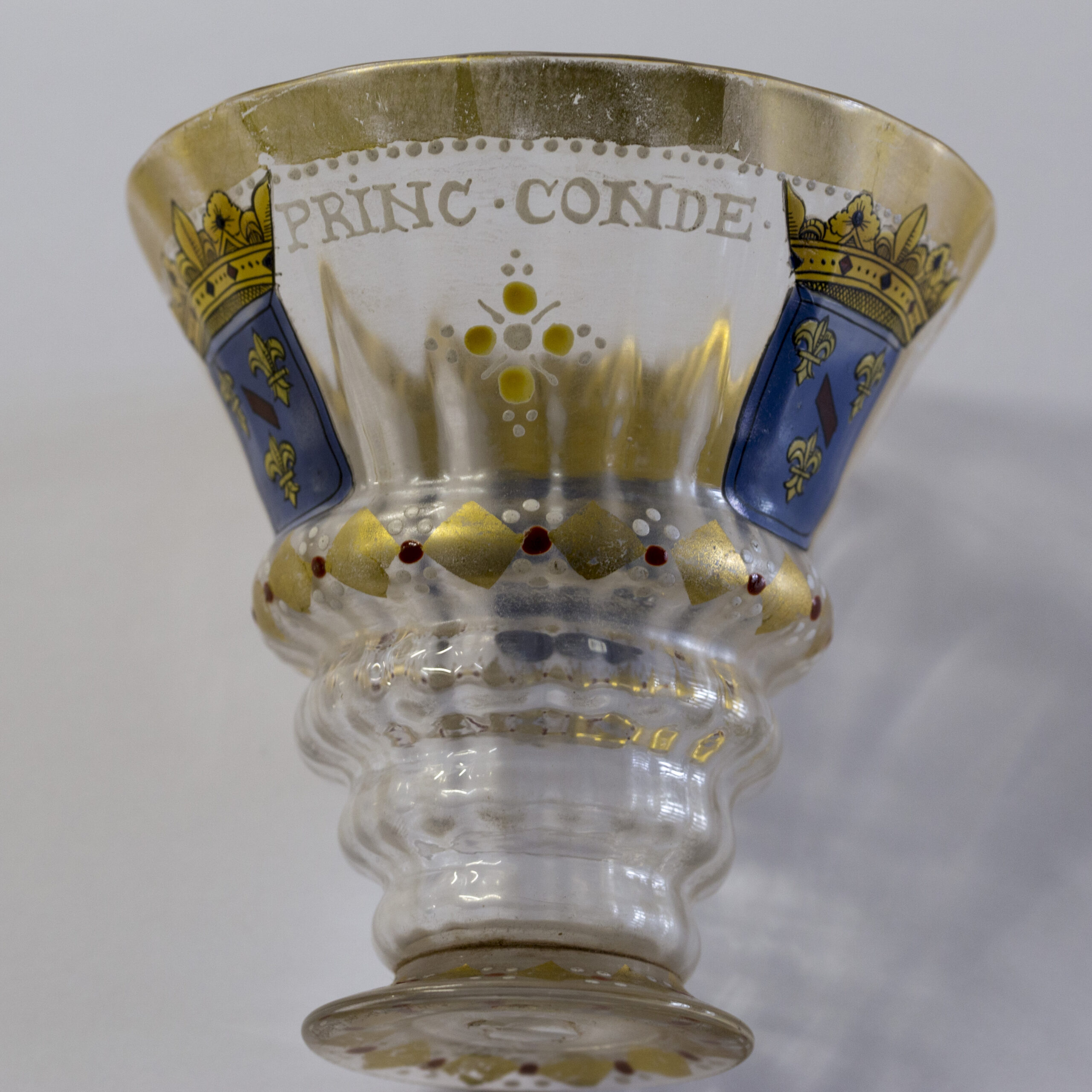
Glass goblet inscribed PRINC CONDE D BORBONI ANNO 1613. Probably Heckert factory, Silesia, 1880s. Casa-Museu Dr Anastácio Gonçalves, Lisbon, inv. CMAG 1300.
3- Why do you think collecting is an interesting topic?
I think collectors are fascinating people and their motivations for collecting are really intriguing. By studying the topic we learn about the very interesting reasons why people collect. And, of course, the objects are often absolutely fascinating, have an interesting history, or come to us without a history and so it’s really exciting to research what those histories are. And there are such interesting reasons why people collect. For instance, I was reading about the Camondos in the The Evolving House Museum. You know, the idea that they came to France just prior to the Franco-Prussian war and were collecting eighteenth-century French art in a way to integrate themselves into French society. With Richard Wallace, he was separated from his mother as a child, and then he was obliged to sell his art collection, in the late 1850s, and when he had the opportunity to buy some of those pieces back, in the early 1870s, he did so. It is the idea of finding loss very difficult to cope with, borne out of his own personal experience as a child, that was, I’ve speculated, a partial motivation. Hence, I think there are all sorts of fascinating reasons why people collect, and the objects of course are so diverse and so interesting.
4- Do you collect? And if so, what do you collect?
Many years ago, decades ago, I started by collecting English pressed glass, because it was affordable and also very decorative, and there was a wide variety of forms. And although I’ve kept that collection, which isn’t huge, it’s probably about 20 pieces, I stopped collecting because we have three sons and one of them was ball mad and I just thought it was crazy having a display of glass in the house with children who play with things like balls. So I stopped and I haven’t really revised that collecting anymore. In fact, the things I’ve been buying over the last ten or twelve years have been related to my research interests. One of them is a bronze by Émilien, comte de Nieuwerkerke, who was the surintendant des Beaux-Arts under Napoleon III, in the 1860s. It represents the death of the Duke of Clarence. I think it’s probably still the first known model by him as a sculptor. I think it was first produced by Susse Frères in 1839. Mine is dated 1858. I did a lot of research on the comte de Nieuwerkerke, whose entire collection was bought by Sir Richard Wallace in 1871. In addition, I’ve only collected three other things since buying the sculpture. One of them is a little portrait of Henry Danby Seymour, a Victorian collector on whom I’ve done quite a lot of research. I came across a little silverpoint of him when he was about seven. And then the other two things are really quite fun as well: because I specialised in Limoges painted enamels, I’ve got two painted enamels made in France in the later nineteenth century in sixteenth-century Limoges style. One of them is certainly a fake. It is a portrait purportedly signed ‘LL’, for Léonard Limousin (the great Renaissance enameller from Limoges), and it depicts one of the mistresses of François 1er. It’s dated ‘1567’ on the portrait and then on the enamel frame ‘1568’.
And the other one, which I bought a couple of years ago, is a beautiful polychrome dish depicting a Genesis subject from the story of Abraham. The same print was a source for two late 16th-century enamels in grisaille by Pierre Raymond (one in LACMA and the other in the Louvre). But my enamel’s got the tiny mark used by Samson, the late nineteenth-century firm that made ceramics and painted enamels in historical styles and was based in Paris. Samson’s dish seems likely to have been inspired by the version in the Louvre. So they reflect my interest in enamels.
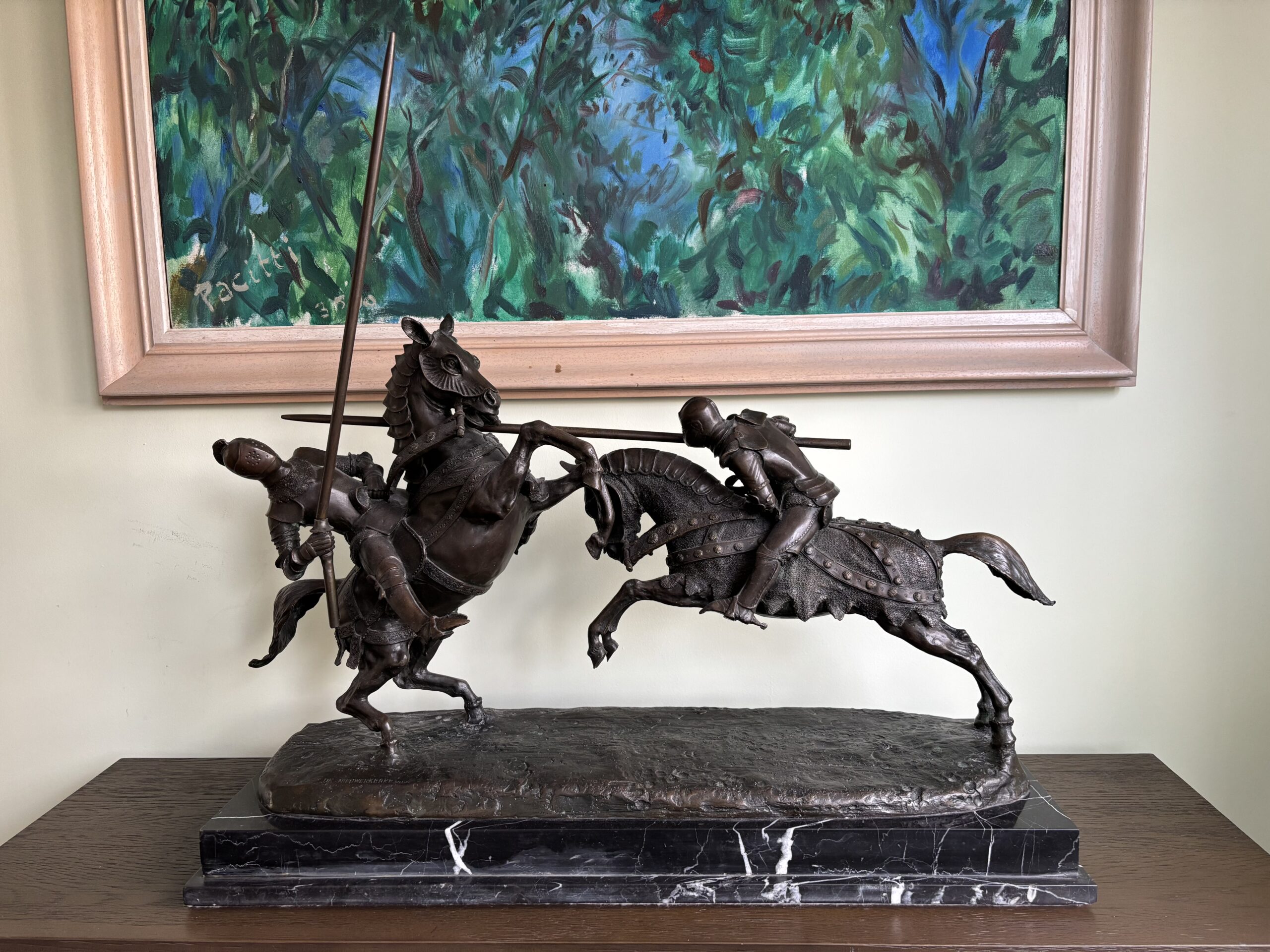
Alfred-Émilien O’Hara de Nieuwerkerke (1811–1892), The Death of the Duke of Clarence, bronze, cast by Susse Frères, Paris, 1858.
5-If you could buy or collect anything in the world, what would it be?
I had quite a lot of trouble thinking about this question and then I thought that, actually, there is this amazing glass tabletop made by the very innovative, entrepreneurial glassmaker Bernard Perrot, who lived in the late seventeenth century. He was from Altare in Italy, but he moved to France and he ended up working in Orléans. And he was given a patent by the duc d’Orléans, the brother of Louis XIV, to make glass and he did all sorts of innovative things. But the really extraordinary thing he did was this tabletop, which incorporates several glass-making techniques. It was in the collection of Louis XIV by 1681, and it was sold from the collection in 1752 and actually bought by somebody called Boucher, but we don’t know whether it was the artist. It’s a completely extraordinary accomplishment. There’s nothing else like it in existence really, and it’s decorated with vetro a filigrana (glass canes forming patterns), millefiori flowers, and the Judgment of Paris illustrated in quite an innovative way. I think it’s the most phenomenal thing, but there was a temporary export ban on it last year and it was valued at £7.5 million so I don’t think I will ever be able to afford it! But it would be amazing to have and completely stunning. You’re overwhelmed when you see it, it is fabulous.
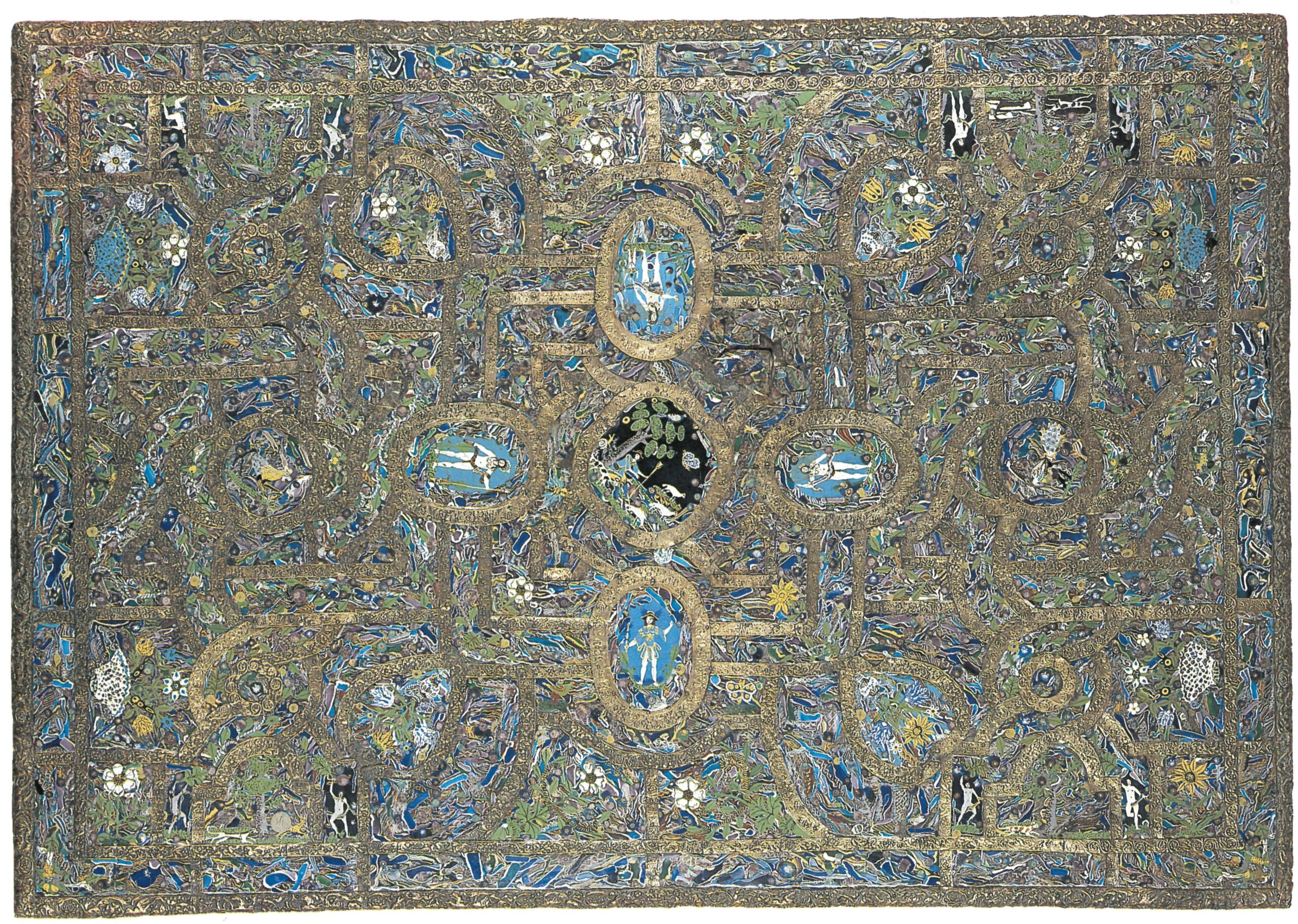
Glass tabletop by Bernard Perrot (1640–1709), France, c. 1668–80. © Sotheby’s Image Archive.
Suzanne was interviewed by Martina Fusari on 14 March 2025.