COLLECTING WITH A VIEW: A series introducing the research and collecting interests of our Steering Committee members.
What are you reading at the moment?
I’m reading a marvellous book that has just come out: William Parente’s Tombs of My Ancestors, printed last month.
He inherited Welbeck Abbey, the house of the Dukes of Portland, and has written a wonderful book about some of his most distinguished—and sometimes most notorious—ancestors.
Bess of Hardwick, who was one of the great Elizabethan dynasts, married four times and inherited a fortune each time her husband died. Then there was the first Duke of Newcastle—that’s the Cavendish dukedom—the Duke of Newcastle created for the Holles family, and eventually the Harleys, the Earls of Oxford, and then, ultimately, the Dukes of Portland. You can see the family tree illustrated in the book.
He’s an amateur historian, but, like many amateurs, his aperçus are extremely good. He has a fantastic grasp of history, and he writes wittily and amusingly.
It’s fresh from the press, beautifully produced and handsomely bound.
I love reading. I bought my first eighteenth-century book at the age of 14: a copy of The Pilgrim’s Progress. The paper smelled nice. It was proper paper, not a sort of plasticated paper of mass-produced books, and I loved the tactile nature of the title page. If you put your finger under the page, you could feel the depression where the hot-metal type had actually pressed into the paper. I thought that was a wonderfully tactile aspect of printing. It was also handsomely bound in full calf, with a ribbed spine—much more exciting than anything I had in my nursery.
Of course, it cost 21 shillings, which was a fortune in those days.
What are you working on at the moment?
I’m writing—or compiling, I should say—something very ambitious: a Dictionary of British and Irish Art Collectors, 1600–1939. That includes, obviously, Scottish and Welsh art collectors. There are about 750 names on my list.
It’s quite a big endeavour. I expect to write over 400 of the entries. The secret to getting it done is that I’ve invited friends, scholars, colleagues, descendants and curators to write articles on collectors they know far better than I do. The result, when it comes out, is going to be thanks to a glorious roll call of the great and good in the history of provenance and collecting.
It won’t be printed in hard copy because it’s simply too huge. I estimate it will run to about a million and a half words. So, it will be online only, hosted by the National Gallery in the research section of its website, once that has been revamped.
I’ve spent my whole life studying the British as art collectors and forming a library on this subject, which is destined to pass to the National Gallery after I die. It seemed sensible also to put down in writing summaries of what we know about the principal collectors in the UK and Ireland: every article contains sections on biography, collection and taste, sales and dispersals and a select bibliography. This will be available, via the web, to scholars and researchers anywhere in the world.
I thought that, although there are younger scholars who know or will discover more than I do about many individual collectors, it would be useful to record in one place and in writing what is known, or knowable, at this stage so that younger scholars can take it forward as more information becomes available.
Just last month, in June, I sent 375 articles to the National Gallery. So half the book already is with the publisher. The Gallery will copy-edit these articles and then the IT department will convert the Word documents into fully searchable online text.
The other reason I wanted to write this Dictionary is that, following the death of the collector and the dispersal of the collection, it doesn’t take many decades for that collector to be forgotten. One thing I want to do with this book is bring back into the sunlight collectors whose collections were often unbelievably distinguished, but which were dispersed 100 or 200 years ago and whose owners have simply become erased from popular memory.
I’m also very keen to talk about women collectors, to make sure that we wave the flag for female collectors. And I want to wave the flag for the decorative arts too. Because this is the National Gallery, you might think this dictionary is confined to collectors of pictures and drawings only, but I very much want furniture and ceramics, medieval antiquities and Renaissance bronzes to be included too.
Among my wonderful contributors, the descendants include Lord Salisbury, who has written on William Cecil, 1st Lord Burghley. It’s a wonderful article because he has encompassed not just pictures, but architecture, gardening and music—all of which were part of the achievements and interests of an Elizabethan collector.
Max Egremont has written on the 2nd and 3rd Earls of Egremont; Lord Harewood on the Lascelles family, Earls of Harewood; Robert Sackville-West on the Sackville family of Knole; and there are others. Lord Cholmondeley has written on Sir Philip Sassoon, so we definitely go into the twentieth century.
Then there are the curators. Again, I’ve been extraordinarily lucky. Almost no one has declined the invitation to contribute. To name only a few, Lauren Batt, archivist at Welbeck Abbey has written on the 5th Duke of Portland; David Connell has written on William Constable of Burton Constable and on the Ingrams of Temple Newsam House; John Culverhouse on the Marquesses of Exeter and the Burghley House Cecils; Stephen Lloyd on the Earls of Derby; and John Martin Robinson on the Dukes of Norfolk. They are the leading authorities on their own subjects. There are too many independent scholars to mention everybody by name, but Brian Allen, Caroline Dakers, Oliver Fairclough, Michael Hall, Professor Peter Humphrey, David McKitterick, James Miller, Nicholas Penny, Francis Russell, Kim Sloan and Jonny Yarker are among them.
You see why I say I’m very fortunate in all my contributors!
It’s intended to be published online only, to coincide with the reopening of the National Gallery Research Centre in the autumn of 2028.
That’s what I jump out of bed every morning and think about
Why do you think collecting is such an interesting topic?
The wonderful thing about the study of collecting is that it’s actually a way of understanding history. People collect for all sorts of reasons, but fundamentally it’s often connected to economic success. Somebody made money, bought or built a house, and needed pictures, silver and furniture to put in it. So it becomes a chronicle of economic success.
The reverse is also true. When a family goes bankrupt, and their collection is sold, it becomes a chronicle of economic failure. It can also be a history of taste. People collected different things in different generations. Sometimes it’s a testament to military conquest and a collection is formed as a result of military achievements.
Sometimes it’s social history. Families make money and go up in the world. Sometimes families die out in the male line, so the family estates and collections carry on in another family.
It’s a record of all of that.
And, of course, collectors come in all shapes. They can be greedy, fastidious, collectors of sets, magpies, aesthetes and historians. Some collect in a pioneering way, ahead of taste; others are retrospective collectors who want to do what their fathers or parents were doing.
And then you get the supreme arbiters of taste. I’m thinking here of Horace Walpole and William Beckford. It wasn’t just the individual objects they collected, although some of those are pretty marvellous; it was also the way they were displayed within each room, and the way one room unfolded into the next. I think they are the consummate collectors.
The study of collecting gives you all of that.
And then, I suppose, there’s another more recent but more sinister reason. After the Second World War, spoliation became an issue in a way that I don’t think it had been before. Before any museum buys a picture, it has to have a clean provenance for the relevant years.
Do you collect, and if so, what?
Please look around!
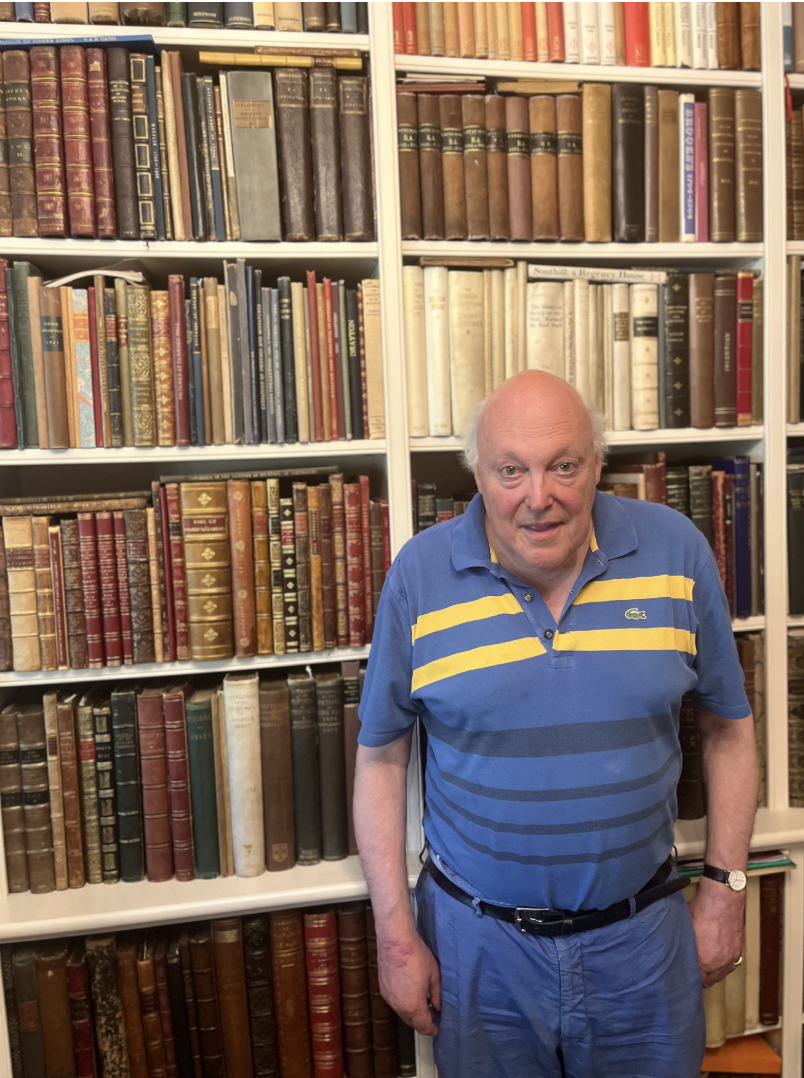
(The interview took place at Charles Sebag-Montefiore’s house, surrounded by his stunning library collection of books and manuscripts, assembled over the past 55 years and devoted to the study of British art collectors and patrons, as well as the provenance of paintings and the history of collecting).
I would like to show you some of the highlights: I think we have to start with King Charles I. This is a manuscript, dated 1649: An Inventory of the Pictures of the Late King Charles I, Which Were Appraised and Sold by the Rebels in the Year of Our Lord, 1649. It’s a list of the King’s pictures, very legible and the pictures are easily identifiable. The inventory is organised by the palace in which the pictures were hung – Greenwich, Wimbledon, Nonsuch, Hampton Court, as well as the two palaces which displayed the King’s greatest pictures – St James’s Palace and Whitehall Palace. This is a wonderful inventory, which derives from the sale documents rather than from van der Doort’s inventory.
Another highly significant manuscript is The Right Honourable the Earl of Orford’s Collection of Pictures at Houghton Hall, Norfolk, 1743. It’s written in a scribal hand, room by room, and the significance of it is that Robert Walpole fell from power in 1742. He gave up his three London houses—Chelsea, Downing Street and Grosvenor Street—and moved all the pictures to Houghton. This manuscript is the first inventory of Houghton after the integration of the London pictures. The sequence of Houghton catalogues is interesting. There’s an inventory from 1736, now in the Pierpont Morgan Library. Then comes mine from 1743. In 1744 there’s one in the Hertfordshire County Record Office. In 1745 Walpole died, and you enter the territory of executors’ lists and so on. They’re all at Houghton with Lord Cholmondeley, and in 1747 Horace Walpole wrote his Aedes Walpolianae, which is his great but posthumous tribute to his father and his collection.
But to talk about something more twentieth-century, I have the two-volume catalogue of pictures from the Holford Collection at Dorchester House. It was printed in 1927, when Sir George Holford died, shortly before the whole collection was put up for sale by auction. It’s very handsomely printed at the Oxford University Press on handmade paper.
I do annotate my catalogues, always in pencil, writing notes about the whereabout of the various works of art both before they entered the collection in question and (after any sales) the subsequent owners. The information comes from auction catalogues and museum catalogues. I have been adding notes and newscuttings to the catalogues in my library for the past 50 years.
The last book I would like to mention is the catalogue of the greatest collection to have been formed in Britain in the late nineteenth century: the Cook Collection, at Doughty House, Richmond, begun in the 1860s by Sir Francis Cook, 1st baronet. Rather amusingly, I bought this copy of the abridged 1932 catalogue in 1976 at Blackwell’s in Oxford, reduced from £3.60 to £1. The paintings listed are by artists such as Clouet, Poussin, Gainsborough, Turner, Fra Bartolomeo, Crivelli, Fra Filippo Lippi and Fra Angelico, El Greco, Velazquez, Rembrandt, Rubens and so on. The dispersal began in 1939 and continued steadily in subsequent years.
If you could buy anything in the world, what would it be?
Would you allow me to buy something that doesn’t exist? Doctor Who’s time machine! I would love to go back in time and see King Charles I’s collection in all its glory and the Houghton collection before the third Earl sold his grandfather’s pictures to the Empress Catherine of Russia. I’d like to see Hamilton Palace in its prime—the greatest collection ever put together in Scotland, sold in 1882. I’d like to go to the two houses whose catalogues I showed you: Dorchester House, to see the Holford pictures, all sold up in 1927 and 1928. And the Cook collection, which was not very far from here, at Doughty House in Richmond in Surrey. And Thomas Hope’s house at Deepdene. I’d like to go there. I think my time machine would be pretty busy.
If there’s no time machine, I’d settle for the great Florentine tondo depicting the Adoration of the Magi by Fra Angelico and Fra Filippo Lippi from the Cook Collection and since 1952 in the National Gallery of Art in Washington.
CHARLES SEBAG-MONTEFIORE INTERVIEWED BY MARTINA FUSARI- 29 July 2026